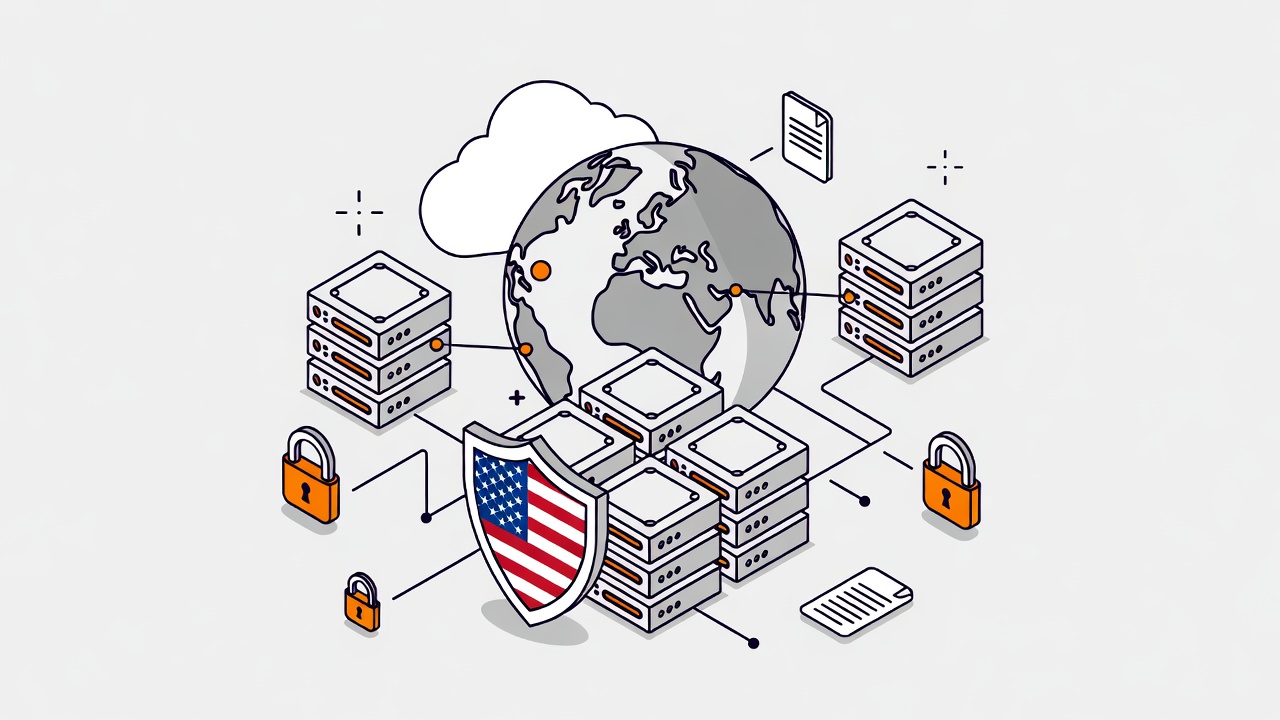
Data sovereignty in 2026: why your cloud provider's location matters more than ever
March 13, 2026

Aron Wagner
CEO & Co-Founder
Where your data lives used to be a technical detail. In 2026, it's a strategic decision that affects your legal exposure, your compliance posture, and your independence as a business.
Sovereign cloud spending hit $80 billion this year — up 35.6% from 2025. That's not a trend. That's a fundamental shift in how businesses think about cloud infrastructure. The question is no longer "should we move to the cloud?" It's "whose cloud, in what country, under whose laws?"
If you haven't thought about data sovereignty yet, now is the time. Here's why it matters and what to do about it.
What data sovereignty actually means
Data sovereignty is the principle that data is subject to the laws of the country where it's stored. If your data sits in a US data center, US law governs it. If it's in Germany, German and EU law applies.
This sounds straightforward until you factor in how modern cloud infrastructure works. The major hyperscalers — AWS, Azure, Google Cloud — operate globally. Your data might be replicated across regions you didn't choose. Backups might live in jurisdictions you didn't consider. And the legal frameworks governing access to that data are more complex than most businesses realize.
The US CLOUD Act is a prime example. It gives US law enforcement the ability to compel US-based companies to produce data stored anywhere in the world. If your business uses AWS, Microsoft Azure, or Google Cloud, the US government can request access to your data regardless of which region you selected — because the provider is a US company.
For businesses outside the US, this creates a direct conflict with local data protection laws. For US businesses, it means your "data residency" selection might matter less than you think if you're on a hyperscaler with global operations and complex legal obligations.
The geopatriation trend
Analysts project that 20% of workloads will shift from global public clouds to local or regional providers by 2028. This trend — sometimes called geopatriation — is driven by three forces:
- Regulatory pressure. New data protection laws in the EU, India, Brazil, and dozens of other countries are tightening requirements around where data can be processed and stored. Compliance on a global hyperscaler is getting harder, not easier.
- Geopolitical risk. Businesses are increasingly wary of storing data in jurisdictions where political relationships could change overnight. A trade dispute, a sanctions regime, or a policy shift can suddenly put your data at legal risk.
- Customer demand. End users care about where their data lives. B2B customers are writing data residency requirements into contracts. Consumer awareness of data privacy is at an all-time high.
AI makes sovereignty harder
The AI boom has created entirely new sovereignty challenges that most businesses haven't planned for.
Training data is sovereign. If you're fine-tuning models on proprietary data, where that training happens determines who might have legal access to your training data and the resulting model weights.
Inference data is sovereign. Every query your users send to an AI model carries information. If that inference runs on infrastructure in a foreign jurisdiction, the data in those queries is subject to foreign law.
Model IP is sovereign. Your fine-tuned models represent significant intellectual property. Where they're deployed affects your legal protections.
Most businesses using AI on hyperscalers haven't thought through these implications. Your model might train in us-east-1, but your provider's legal obligations extend far beyond that region code.
What true data sovereignty looks like
True data sovereignty requires more than selecting a region in a dropdown menu. It requires:
- Infrastructure ownership. Your provider should own and operate its data centers, not lease capacity from another provider who might have their own legal obligations.
- Clear jurisdiction. You should know exactly which laws govern your data — and that should be determined by where the data physically resides, not by the corporate structure of a multinational provider.
- No hidden replication. Your data should live where you put it. Period. No surprise replications to other regions or jurisdictions for "redundancy" without your explicit consent.
- Independence from Big Tech supply chains. If your sovereign cloud provider depends on AWS or Azure for underlying infrastructure, your sovereignty is only as strong as the hyperscaler's policies allow. We wrote about why provider independence matters for deplatforming-resistant hosting — the same logic applies to sovereignty.
Building a sovereign cloud strategy
Step 1: Map your data. Understand what data you have, where it currently lives, and what regulatory requirements apply to each category.
Step 2: Identify your jurisdiction. Decide which legal jurisdiction best serves your business needs. For many US businesses, keeping data on US soil under US law — without the complexity of a multinational provider — is the simplest and strongest position.
Step 3: Evaluate provider independence. Ask hard questions. Does the provider own its infrastructure? What are their legal obligations under the CLOUD Act or equivalent legislation? Who are their upstream dependencies?
Step 4: Plan for AI data flows. If you're building or deploying AI, map the full lifecycle of your data — training, fine-tuning, inference, logging — and make sure every stage meets your sovereignty requirements.
American Cloud: sovereignty without compromise
American Cloud provides US-based, independently owned infrastructure. Your data lives in American data centers, under American law, on infrastructure that doesn't depend on AWS, Azure, or Google Cloud for anything.
No multinational corporate structure creating legal ambiguity. No upstream dependencies that could override your provider's policies. No content moderation policies that give your provider a reason to access or review your data.
With compute, storage, networking, managed databases, Kubernetes, and colocation all available on independently owned US infrastructure, American Cloud gives businesses true data sovereignty — not the "select a region" approximation that hyperscalers offer.
Your data deserves a clear jurisdiction and an independent provider. Build on American Cloud — US-based infrastructure you can actually trust.