Cloud egress fees explained: the hidden tax costing you thousands
March 10, 2026

Aron Wagner
CEO & Co-Founder
You signed up for cloud hosting because the pricing looked simple. Compute by the hour, storage by the gigabyte, pay for what you use. Then the first real bill arrived and there was a line item you didn't plan for — egress fees.
If you've never heard of cloud egress fees, you're about to understand why your cloud bill is higher than it should be. And if you have heard of them, you already know they're one of the most frustrating costs in cloud infrastructure.
What are cloud egress fees?
Egress fees are what cloud providers charge you for data leaving their network. Every time a user downloads a file from your app, every time you transfer data to an external service, every time you pull a backup to local storage — you're paying egress.
The pricing looks small on paper. AWS charges roughly $0.09 per gigabyte for standard data transfer out. But cloud workloads move a lot of data. A mid-size SaaS application serving 50,000 users can easily transfer several terabytes per month. At $0.09/GB, that's hundreds or thousands of dollars — just for the privilege of your users accessing their own data.
Here's what makes it worse: egress fees are unpredictable. Traffic spikes, a viral moment, a customer running a large export — suddenly your data transfer bill doubles and you had no way to forecast it.
The scale of the problem
Over 60% of IT leaders report exceeding their cloud budgets, and egress fees are a major contributor. For storage-heavy workloads, egress can increase your total storage bill by 3x to 5x. You're not just paying to store data — you're paying every time that data moves.
The pricing gap across providers is staggering. Research shows a 127x cost difference between the cheapest and most expensive cloud providers for data transfer. That's not a rounding error — it's a fundamentally different business model.
Machine learning teams get hit especially hard. Moving 1TB of model checkpoints costs $90 on AWS. Training pipelines that shuffle data between storage and compute racks up egress charges with every iteration. Teams building AI products on hyperscalers often discover that data movement costs rival their actual compute spend.
Egress fees are a lock-in mechanism
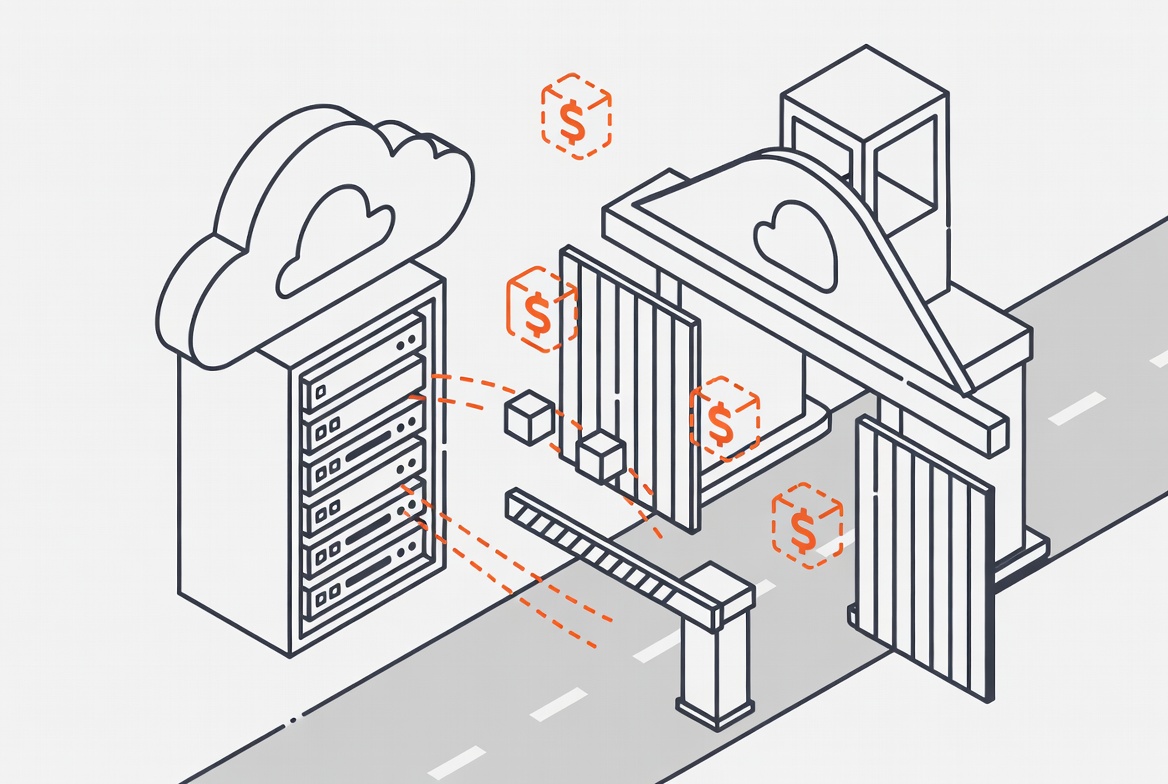
Let's call it what it is. Egress fees aren't just a cost — they're a strategy. When it costs $90,000 to $120,000 to move a petabyte of data off AWS, that's not pricing. That's a wall.
Cloud providers make it cheap to get data in and expensive to get data out. Ingress is typically free. They want your data on their platform, and they want leaving to hurt enough that you stay even when the economics don't make sense.
This is why the EU passed the Data Act in 2025, specifically targeting egress fees as an anti-competitive practice. Regulators recognized what customers already knew: egress fees are the cloud industry's version of early termination penalties.
For businesses evaluating their cloud strategy, the egress question is simple: can you afford to leave? If the answer is no, you're not a customer — you're locked in. If you're considering the move, we wrote a full guide on how to move your workloads off AWS.
What egress fees actually look like
Here's a rough comparison for standard data transfer out to the internet (for ten clouds priced at 1, 5 and 20 TB a month, see cloud providers with no egress fees):
- AWS — $0.09/GB (first 10TB), $0.085/GB (next 40TB), $0.07/GB (next 100TB)
- Azure — $0.087/GB (first 5GB free, then tiered)
- Google Cloud — $0.12/GB (standard tier), $0.085/GB (premium, tiered)
- American Cloud — $0.00/GB. Zero. No egress fees.
The differences compound fast. A business transferring 10TB per month pays roughly $900/month on AWS just in egress. Over a year, that's $10,800 — for moving data you already paid to store. On American Cloud, that cost is zero.
And it's not just outbound internet traffic. Many providers also charge for data transfers between regions, between availability zones, and even between services within the same platform. The meter is always running.
How to fight back against egress fees
If you're stuck on a provider with egress fees today, here are practical steps:
- Audit your data transfer patterns. Use your provider's billing dashboard to understand exactly how much data is moving and where. Most teams are surprised by the volume.
- Cache aggressively. Use CDNs and edge caching to reduce origin pulls. Every request served from cache is an egress charge avoided.
- Compress before transfer. Gzip, zstd, or application-level compression can cut transfer volumes by 60-80%.
- Consolidate regions. Multi-region architectures are great for availability but brutal for cross-region transfer fees. Make sure the redundancy is worth the cost.
- Plan your exit. If egress fees are a significant line item, factor the migration cost into your next provider evaluation. Sometimes paying the exit toll once is cheaper than paying the monthly tax forever.
The better model: zero egress
The cloud industry is slowly recognizing that egress fees are indefensible. Cloudflare eliminated them on R2 storage. The EU is regulating them away. And providers like American Cloud were built from the start with a simple principle: your data is your data, and moving it shouldn't cost you a dime.
American Cloud charges zero egress fees — on all services, all the time. Combined with pricing that's 25%+ lower than AWS, Azure, and GCP, the total cost difference is substantial. No hidden charges, no tiered complexity, no penalties for moving your own data.
Stop paying the exit tax. See American Cloud's transparent pricing and start building on infrastructure that doesn't charge you to leave.