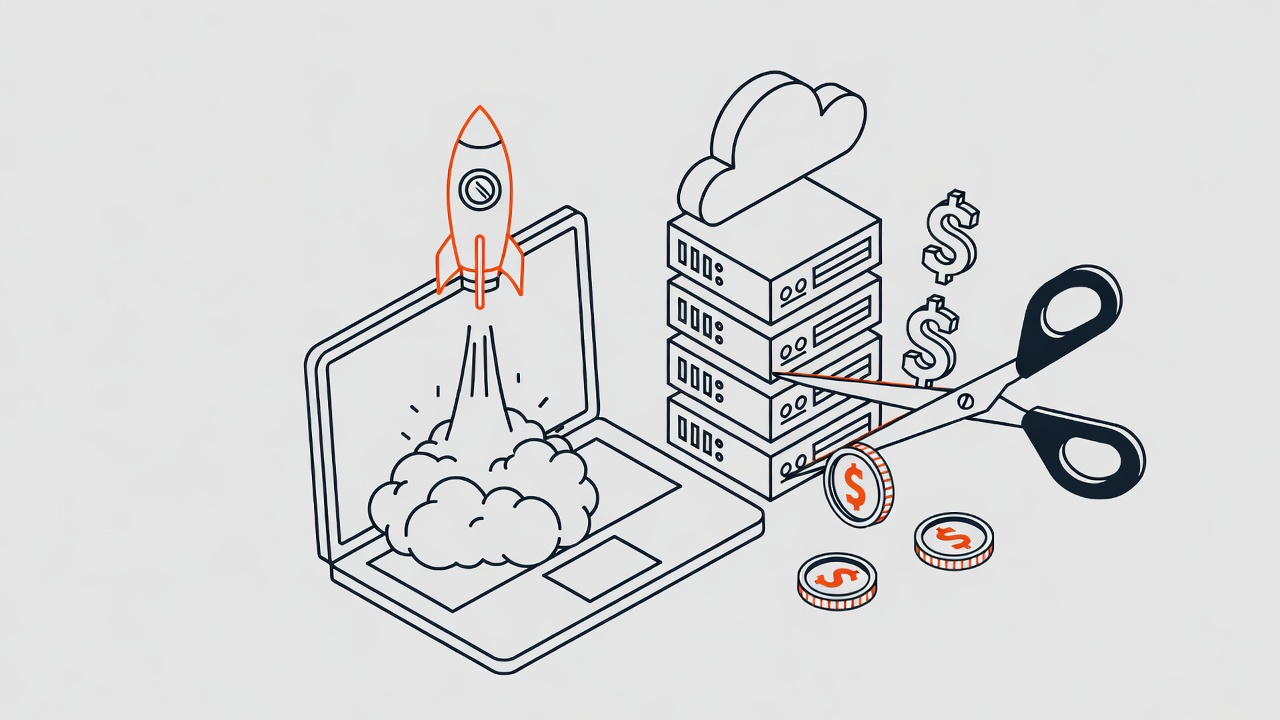
Cloud hosting on a bootstrap budget: how startups can cut infrastructure costs by 25%+
March 16, 2026

Aron Wagner
CEO & Co-Founder
You're building something real. Maybe it's your first SaaS product, an e-commerce store, or a data platform you've been prototyping for months. You've got users — or you're about to. And you just got your first serious cloud bill.
For early-stage startups, cloud hosting can consume up to 80% of gross revenue. That's not a typo. Before you've hired your second engineer or closed your first enterprise deal, infrastructure costs are already eating the budget alive.
The average baseline hosting cost for a startup with moderate traffic runs around $12,000 per month on a major hyperscaler. Most teams overspend by 30-40% before they learn enough about the platform to optimize. By then, they're locked into architectural decisions that make switching painful.
It doesn't have to be this way.
The hyperscaler trap
AWS, Azure, and GCP all run the same playbook for startups: generous free tiers, startup credits, and "getting started" programs that subsidize your first year. The pitch works. You build your app on their platform, use their proprietary services, and everything feels free — until the credits expire.
Then reality hits. That managed database that cost nothing in the free tier is now $400/month. The load balancer you set up without thinking about it is billing hourly. Data transfer between your services is generating egress charges you never anticipated. And the serverless functions that seemed like the cheapest option are now your biggest line item because your traffic grew.
This is by design. The free tier isn't generosity — it's a customer acquisition strategy. The goal is to make you dependent on platform-specific services so that by the time you're paying full price, migrating away is too expensive to consider.
Practical strategies to cut cloud costs
Whether you're starting fresh or trying to reduce an existing bill, these strategies work:
Right-size your instances. Most startups over-provision from day one. You don't need an 8-core, 32GB instance to serve 1,000 daily users. Start small, monitor actual resource usage, and scale up only when metrics demand it. Many startups find they can drop down one or two instance sizes and see zero impact on performance.
Avoid proprietary services. Every AWS-specific service you adopt is another link in the lock-in chain. Use PostgreSQL instead of DynamoDB. Use Kubernetes instead of ECS. Use standard S3-compatible storage instead of provider-specific object stores. Portable technology means you can always move to a cheaper provider later.
Choose transparent pricing. The complexity of hyperscaler pricing is a feature, not a bug — for the provider. When you need a spreadsheet and a cost calculator to estimate your monthly bill, something is wrong. Look for providers with simple, predictable pricing where you can estimate costs in your head.
Eliminate egress fees. If your application serves content to users, synchronizes data with external services, or runs backups to offsite storage, egress fees are silently inflating your bill. On AWS, moving 5TB of data per month costs roughly $450 in egress alone. On a provider with zero egress fees, that cost disappears entirely.
Use reserved or committed capacity wisely. If your workload is predictable — and most startup production workloads are after the first few months — committed capacity can save 30-50% over on-demand pricing. But only commit to what you know you'll use. Unused reservations are wasted money.
Monitor relentlessly. Set up billing alerts at 50%, 75%, and 90% of your budget. Review your bill weekly, not monthly. The earlier you catch cost anomalies, the less damage they do.
The real cost of cloud for startups
Let's run some numbers. A typical early-stage startup running:
- 2-4 compute instances for application servers
- A managed PostgreSQL database
- Object storage for user uploads
- A load balancer
- Moderate data transfer (5TB/month outbound)
On AWS, this setup costs roughly $1,200-$1,800/month. On American Cloud, the same workload runs 25%+ cheaper — and the egress component drops to zero.
Over a year, that 25% savings is $3,600-$5,400. For a bootstrapped startup, that's the difference between hiring a contractor and not. Between running ads and not. Between extending your runway by a month or burning through it.
And that's before accounting for the engineering time you save by not wrestling with Byzantine billing dashboards and cost optimization tools. On a simpler platform, your engineers build product instead of managing cloud costs.
What startups actually need from a cloud provider
Strip away the hype and startups need five things from their cloud:
- Compute that scales. VMs or containers that you can resize as your user base grows.
- Managed databases. Because your two-person team shouldn't be managing PostgreSQL replication at 2 AM.
- Object storage. For user uploads, static assets, and backups.
- Networking that works. Load balancing, DNS, and firewalls without a PhD in network configuration.
- Predictable pricing. So you can plan your burn rate with confidence.
You don't need 200+ services. You don't need AI model hosting, IoT gateways, or quantum computing simulators. You need solid, reliable infrastructure at a price that doesn't threaten your runway.
Build lean. Build independent.
The best infrastructure decision you can make as a startup is to stay portable and stay lean. Use open standards. Avoid proprietary lock-in. Choose a provider that charges you fairly from day one instead of one that lures you in with credits and raises prices later.
American Cloud gives startups everything they need — compute, storage, networking, managed databases, and Kubernetes — at 25%+ less than AWS, Azure, and GCP. No egress fees. No hidden costs. No free tier bait-and-switch. Just straightforward infrastructure priced for businesses that count every dollar.
Every dollar matters when you're bootstrapping. See how much you can save with American Cloud's transparent pricing — and put the savings back into building your product.